

Every boat owner operating in the waters of the U.S. should know the coast guard boat requirements. A recreational boat or vessel must comply with federal safety standards whether you operate a small craft or a larger documented vessel. The rules are meant to safeguard passengers; protect the marine environment; and reduce accidents in navigable waters.
Many boaters believe regulations only apply to commercial vessels. In truth, leisure craft usually must conform to certain standards for equipment, documentation and display. Not complying can lead to penalty, failed inspections or safety issue.
The U.S. Coast Guard sets uniform safety regulations for the United States. These standards include equipment for life saving, fire protection, ventilation, and pollution control. Compliance allows ships to continue to be safe and legal.
This guide discusses federal safety regulations, equipment needed on board, placard requirements, and inspection standards. By adhering to these protocols, you can safely navigate your boat while fulfilling all federal requirements.
Summary of Coast Guard Boat Requirements
The definition of coast guard boat requirements are federal regulations relating to safe and environmentally sound vessels. Rules for recreational and commercial vessels in U.S. waters.
Vessel size and type affect requirements. Smaller boats are obliged to fit lesser equipment. Larger boats will have more safety equipment.
Federal regulations cover equipment such as life jackets, fire extinguishers and navigation lights. It also provides to prevent pollution.
| Requirement | Under 26 Feet | 26 Feet or Longer |
|---|---|---|
| Personal Flotation Devices | Required | Required |
| Fire Extinguisher | Required (if enclosed spaces) | Required |
| Garbage Placard | Not Required | Required |
| Oil Discharge Placard | Not Required | Required (with machinery) |
Federal standards maintain the same safety across states. By complying, the risk accidents are reduced and help in conserving the marine habitat.
Annually review requirements stated in the above text. on changes made to the vessel or the operational use of such vessel, the regulation may differ.
Maintaining appropriate gear shows responsible ownership. It also gets ships ready for inspection.
Compulsory Safety Equipment and Materials
All Coast Guard boats must carry the right safety equipment. Vessels must have U.S. NOTE. Every individual on board must have personal flotation devices that are approved by the Coast Guard.
Access to life jackets should be easy. Children are usually obliged by additional age-specific regulations to wear flotation devices continuously.
Protection from Fire and Ventilation
Fire extinguishers must carry with vessels of closed fuel compartments. The required amount depends on vessel length.
Proper ventilation systems can help prevent fuel vapor explosions. Gasoline engines in boats must meet ventilation.
Auditory and Visual Cues
Boats must possess sound-making apparatus such as whistles or horns. Bigger ships carry more warning equipment.
Boats using coastal waters must carry visual distress signals.
Essential equipment needs are
- United States Life jackets approved by the Coast Guard.
- Fire extinguishers approved.
- Sound-making tool.
Lights used during night operations
The navigation lights should be in good working condition from sunset to sunrise. Check bulbs and wires frequently.
Frequent equipment tests stop compliance failures. It’s vital to replace old or damaged equipment.
Safety rules safeguard passengers and diminish Vitamin Sea mishaps. Proper equipment makes a person ready.
Requirements for environmental and display
Federal boat safety regulations include environmental protection standards. Central to compliance are pollution prevention measures.
A garbage disposal placard should be the case for vessels 26 feet or longer. Do not throw and litter in the train compartment.
Posters for Pollution Prevention
Vessels having machinery spaces shall be provided with oil discharge placard. It clarifies the regulations against oil pollution and its penalties.
Make sure these placards are easily visible and durable. Faded and/or damaged signs do not comply.
Record and Identify
Federal vessels must display their official number inside the hull permanently. The stern must show the vessel name and the hailing port.
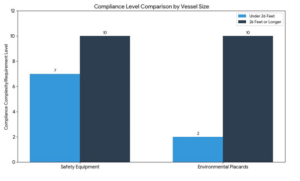
- Vessels greater than or equal to 26 feet are subjected to a higher level of compliance ($10/10$) initially with Environmental placard and advanced Safety equipment, when compared to lower-length boats.
- All boats over 26 feet are mandatorily required to post Environmental Placards such as MARPOL trash and oil discharge posters or stickers in a location in plain view. While often recommended or limited for smaller boats, these placards have now been made mandatory.
- Improved Safety Equipment: Bigger boats are held to a stricter standard for Safety Equipment which frequently includes more fire extinguishers, sound signal devices and life jackets which increase with passengers’ capacity.
Prepping for Coast Guard Boat Requirements
Routine safety inspections ensure compliance with coast guard boat requirements. Inspectors may check your safety equipment, documents, and whether anything obscures the placard’s visibility.
If you prepare beforehand, inspections will be easier. Ensure proper documentation and everything is within reach.
Examine the expiration dates of flares and fire extinguishers. Make sure the navigation lights work.
You have to go through these steps to get ready for Coast Guard Boat Requirements
- Examine all needed safety gear.
- Confirm that signs are clear and unobscured.
- Check document status.
- Check the navigation lights and sound devices.
Through a voluntary Vessel Safety Check, you might identify some issues they may identify later during an official inspection.
Safe and Compliant on the Water – Coast Guard Boat Requirements
Documentation and proper equipment ensure all items are in order, and Vessel Placards help maintain clear vessel identification. Although larger vessels have additional obligations, these remain manageable with regular monitoring.
Regular maintenance and inspections can reduce risk. Having responsible ownership will promote waterways safety.
In conclusion, Coast Guard standards protect your vessel and the people on your vessel. When you stay informed and prepared, you ensure lawful operation and make the maritime community safer.
