
Where you place the name of your boat is important. federally documented vessels are legally mandated while state-registered boats find it useful for identification purposes. Proper placement makes this compliant with US regulations. The Coast Guard regulations will help authorities quickly identify your Boat Name Location.
When choosing lettering styles many boat owners think of looks. Notwithstanding, federal documentation rules dictate the placement and method for a vessel’s name and hailing port. Faulty placement may end up causing inspection complications or compliance notices.
Federal documentation requirements differ from state registration requirements. Knowing these differences allows the identification to be on the right boat.
In the guide, we explain about official name placement rules, hailing port requirements, and the federal versus state system differences. Ensuring legal compliance and a professional look, follow these guidelines when documenting your yacht or refitting your vessel graphics.
Comprehending Ship Title Position Specifications
Whether your boat is federally documented or state registered determines the correct location for the boat name location. An official name and hailing port must appear on the stern of federally documented vessels. The name must be clear and permanently attached.
The hailing port consists of a U.S. city and state. It should be located on the stern above or near the vessel’s name. It should be easy to read and long-lasting.
Different markings rules for registered vessels. Both sides of the hull front must display registration numbers required by the state. State-only boats do not require vessel names.
| Requirement | Federally Documented | State Registered |
|---|---|---|
| Vessel Name Display | Required on Stern | Optional |
| Hailing Port | Required | Not Required |
| Registration Numbers | Not Displayed Externally | Required on Hull Sides |
| Official Number | Inside Hull | Not Applicable |
Federal rules mandate clear labeling. Markings are important as it provides inspection ready legal recognition.
Wrong positioning may cause inspections or document sign-offs to be delayed. Moving ships and cargo fast.
Regulations for Federal Documentation and Stern Placement
In a federally documented vessel, a boat name location must conform to specification. The name of the vessel and hailing port must appear on the stern in a readily visible manner.
The name must be affixed permanently. Decals that are temporary and easy to remove do not comply. The letters should be in contrasting colors from the color of the hull.
Ship’s Port of Requirement
The hailing port must have a U.S. city and state. There is no need for the owner’s residence to be reflected. Nonetheless, it has to be consistent with the documentation.
State abbreviations are allowed for states. The lettering should be readable and last a long time.
Standards for Lettering
While federal law does not specify a letter size, letter height should be visible. Owners generally prefer letters set to at least four inches high.
- Name of the ship on rear.
- Port of call indicated with a location.
- Long-lasting and hard-wearing lettering.
Easy to read clarity
The official document number is not visible outside. It should be firmly fixed within the hull structure.
It prevents marking errors when you know the difference between documented and state-only boats. A stern descriptor is necessary for documented vessels. State vessels use bow registration numbers.
Varities in Outer Impacts – Boat Name Location
State registration numbers must be displayed on the fore hull sides. They need to keep the formatting and spacing rule set up by the state authorities.
Federally documented vessels do not display these registration numbers externally. Identification depends on name and hailing port instead.
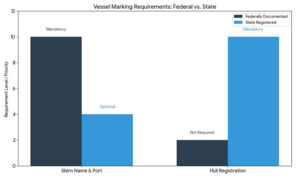
- Primary Identification Priorities: Federal Documentation places a priority on the stem, where a permanent name and hailing port must be displayed in letters at least 4 inches high. Unlike the Private Systems, the hull of State Systems is more important and requires specific registration numbers on their sides.
- A major advantage for Federally Documented vessels is they are generally exempt from displaying registration numbers on the hull so the exterior looks cleaner.
- The hailing port serves as a legal mark of the vessel’s home for federally documented vessels and is mandatory in order for the vessel to have federal status. In contrast, for a state registered vessel, display of a port of origin is optional and carries no legal weight.
Learn where and when to position equipment
Finding the perfect location for your boat name is both compliant and stylish. Start by checking if your boat is federally documented or state registered.
Speed transmission of stern area. Leave enough space for clear letters. Do not put the name too close to the edges or hardware.
Choose vinyl or painted lettering designed for marine use. Saltwater and UV exposure may result in fading over time.
By following these steps, proper installation is assured for Boat Name Location
- check the marking requirement either federal or state
- Choose Weatherproof Materials
- “Position the name and port centrally on the stern.”
- The lettering should contrast with hull color.
After installing, check periodically for wear and tear. Promptly replace faded letters to ensure visibility.
Professional letterers ensure the design complies with the product’s required standards. Proper placement and alignment improve beauty and validity.
Making sure of correct vessel identification – Boat Name Location
The proper placement of the boat’s name is important for the identification of the vessel and compliance with regulations. Every federally documented vessel must display its name and hailing port on its stern. Boats registered with the State must comply with hull number placement rules.
Knowing the difference between the two additional systems helps avoid marking mistakes. Proper placement assists with inspection and documentation processing. Vessel Placards provides durable materials and well-designed solutions for long-lasting use. Consistent inspections help maintain compliance over time.
To sum up, correct vessel marking is not only a legal obligation but also a display of ownership. When you follow the guidelines set out by the authorities carefully, your boat will not only be compliant but also recognizable. Most importantly, it will be professional wherever you operate.
