

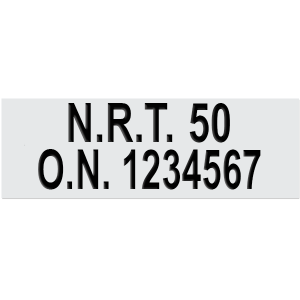
Registered vessels in Canada must meet all registration and marking requirements in order to be compliant, and the display of a Canadian Registry Plaque is a prerequisite. The Canadian Registry Plaque is proof of registration of your boat with Transport Canada.
A Canadian Registry Plaque is an engraved metal plaque on vessels registered under the Canada Shipping Act of Canada. These plaques contain the vessel’s name, the registry port’s name and the registration number. These plaques certify your boat still follows regulations and typically signifies maritime quality.
Understanding Canadian Registry Plaques
An engraved Canadian Registry Plaque bears identifying particulars with respect to a registered vessel. Such a plaque must conform to certain physical requirements to be considered acceptable to Transport Canada with respect to material, engraving and visibility.
| Aspect | Description |
|---|---|
| Purpose | Official identification for registered Canadian vessels |
| Material | Typically solid wood, brass, or high-grade aluminum |
| Information Displayed | Vessel name, port of registry, official number, and tonnage |
| Governing Authority | Transport Canada, Marine Safety and Security Directorate |
People must permanently affix the plaques to the vessel so that they are in a clearly visible location, such as on permanent display near the main entrance or in the wheelhouse.
Importance of Compliance
A properly constructed registry plaque is mandatory in order to comply with the Transport Canada registry under the Canada Shipping Act, 2001, as it is proof that the vessel is registered in Canada, which helps to avoid registration disputes and inspection or sale problems.
Failure to display an approved plaque may incur penalties, or delay approval of other documentation.
Key Features and Standards of Canadian Registry Plaques
If you are building or purchasing a Canadian Registry Plaque, here are the design elements required.
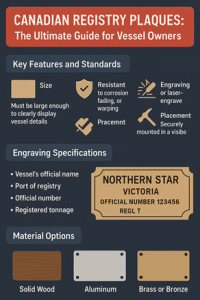
- Size: Must be large enough to clearly display vessel details.
- Material Durability: Resistant to corrosion, fading, or warping in various environments.
- Engraving Method: Deep-etch or laser-engrave for long-lasting durability.
- Lettering Style: Use block letters for maximum legibility.
- Placement: Securely mount the plate in a clearly visible area of the vessel.
Engraving Specifications
Each Canadian Registry Plaque must show:
- The vessel’s official name.
- The port of registry (city of registration).
- The official number registered with Transport Canada.
- The registered tonnage.
This confirms the ownership and national identification associated with the registration certificate you received.
Material Options
Common materials used include:
- Hardwood Plaques – Classic, customary look on yachts and sailboats.
- Aluminum Plaques – Lightweight, corrosion resistant metal used in commercial vessels.
- Brass or Bronze Plaques – Highly durable with an elegant finish.
Selecting the right material depends on your vessel’s design, exposure conditions, and aesthetic preference.
Legal Requirements for Canadian Registry Plaques
Vessels on the Canadian Registry of Vessels are marked with a plaque that meets the requirements set out by Transport Canada, so that they can be positively identified and traced in Canadian and foreign waters.
Placement and Permanence
The plaque must be:
- Hull attachment occurs with screws, bolts, or marine grade adhesive.
- Usually installed within an accessible area, such as the main cabin or near the helm.
- Legible and visible at all times to the eye.
Plaques temporary, removable, or obscured are not considered acceptable.
Information Accuracy
All engraving must match the information on your Certificate of Registry and if your plaque and your document differ, that is likely non-compliant.
Requirement Details
- Vessel name Must match official Transport Canada registration
- Port of registry Listed city under documentation
- Official number Issued by Transport Canada
- Gross tonnage as recorded in vessel documentation
From these small typographical errors, administrative delays can arise, or the plaque may need replacing.
Canadian Registry Plaques differ from Pleasure Craft License (PCL) numbers in their issuing authority, application, and permanence, though they both serve to identify vessels.
| Feature | Canadian Registry Plaque | Pleasure Craft License |
|---|---|---|
| Authority | Transport Canada Registry of Vessels | Pleasure Craft Licensing System |
| Applies To | Commercial and documented recreational vessels | Small pleasure boats under 15 gross tons |
| Identification | Vessel name, port, and official number | License number only |
| Display | Engraved plaque inside vessel | Painted on hull exterior |
| Renewal | Permanent until ownership changes | Requires periodic renewal |
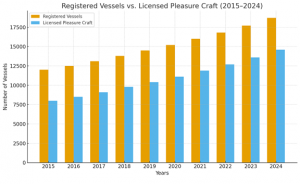
- Registered vessels increased steadily from about 12,000 to nearly 18,700.
- Licensed pleasure craft also rose from around 8,000 to approximately 14,600.
- The data indicates a growing interest in boating and recreational water activities.
- The upward trend suggests increased demand for vessel registration plaques.
This trend reflects how more vessel owners opt for formal registration to secure ownership recognition, financing eligibility, and international navigation rights.
Steps to Obtain or Replace a Canadian Registry Plaque
Ordering a Canadian Registry Plaque is straightforward, provided the correct details of the vessel and the relevant dimensions and style are carefully specified.
Check your registration
Confirm the details of your vessel and its Canadian Register of Vessels number are right. Register any ownership transfer, name change, or port change before engraving the plaque.
Choose the Material and Style from Options
Choose your placards material. Because it lasts and looks nice, people recommend aluminum or brass in commerce. Some private yachts are decorated by wooden plaques.
Supply details that are accurate.
When ordering, please provide:
- Vessel name (exact spelling).
- Port of registry (city name).
- Official number.
- Gross tonnage (if applicable).
Approve the Proof and Final Payment
Most suppliers send a digital proof of your plaque design. Check all spellings carefully, as if errors are found after engraving, the plaque is usually reordered.
Install Properly
When people receive it, they should mount the plaque in the agreed location using corrosion resistant fixings.
Common Mistakes When Ordering Canadian Registry Plaques
When someone orders or replaces a plaque, avoid making these common mistakes so it can pass a vessel inspection and comply with Coast Guard regulations.
Mistake Impact Solution
- Incorrect vessel name invalidates compliance; double-check with registration.
- Wrong port of registry causes documentation discrepancies; verify the port listed on the Transport Canada certificate.
- Low-grade materials result in a short lifetime; use marine-grade HDPE or marine-grade wood.
- Poor engraving visibility fails inspection; ensure lettering is deep-etched.
Real Example
The Vancouver yacht owner who ordered a plaque with his yacht name spelled incorrectly was found out by the compliance officer and his plaque was replaced, showing that care must be taken both in the ordering and installation of plaques.
Practical Tips for Maintaining Your Plaque
Routinely maintain your Canadian Registry Plaque to keep it legible and compliant for many years.
- Cleaning: Clean by use of mild soap and water while avoiding harsh chemicals that can damage engraving.
- Inspect fasteners: These screws must be tightened or replaced annually.
- Direct sunlight exposure requires UV-resistant coating application or treatment to prevent sun damage.
- When Needed: Order a new plaque if it becomes unreadable on or vessel ownership changes with.
Vessel Inspection Success
When Transport Canada randomly checked a commercial tugboat registered in Halifax for compliance with regulations on board, someone engraved the Canadian Registry Plaque correctly and secured the plaque to the boat properly.
- The inspector commented that placing the plaque correctly and using corrosion-resistant materials would save vessel owners having to pay for a fine or re-inspection.
- This example illustrates that compliance and rigorous attention to quality are necessary best practices of responsible and accountable ownership.
Ensuring Compliance and Pride in Ownership
Vessel Placards is an indication of maritime pride, and is required under Canadian law, for registering ships under the flag of Canada. The plaque can also lend professionalism and credibility to any ship.
By understanding Transport Canada’s regulations, using proper materials to create your plaque, and taking care of it, your vessel will have the proper identification and safety requirements.
